Tag: systemsanalysis

  • How Anthropic’s Own Copy Constructed the Expectation It Then Violated

    Information Design Analysis: Subscription Tier Signaling UX

    4.1 — The Complete Verbatim Signal Corpus: What The Pricing Architecture Actually Said

    Before analysis, the exact language must be on record. This is the complete set of purchase-point signals a developer encountered:

    Max 5x ($100/month) — Official Anthropic copy:
    “Great for frequent users who work with Claude on a variety of tasks, with 5x more usage per session than Pro.” npm

    Max 20x ($200/month) — Official Anthropic copy:
    “Perfect for daily users who collaborate often with Claude for most tasks, with 20x more usage per session than Pro.” npm

    Help Center — Official Anthropic feature description:
    “No more interruptions: Stay in flow when it matters most with higher usage limits that allow for deeper, more extensive work with Claude.” PyPI

    Third-party synthesis of Anthropic positioning (Global GPT — directly citing Anthropic language):
    “These plans are not just about ‘more messages’; they are about enabling a level of autonomy that Pro plans cannot sustain. Max Ultimate ($200/mo): This tier provides 20x the usage of Pro, effectively removing the concept of ‘limits’ for individual users.” npm

    Max 5x positioning — developer-specific:
    “Built for the ’10x Developer,’ this plan offers 5x the usage limits of Claude Pro. It is specifically optimized for those using Claude Code (the terminal-based agent), allowing the agent to run background tasks like refactoring an entire repository or running local test suites without interruption.” npm

    These are not marketing aspirations — they are specific, documented, purchase-influencing representations made by Anthropic at the point of subscription decision.

    4.2 — Semiotics of the Pricing Copy: Signal-by-Signal Deconstruction

    Applying Barthes’ denotation/connotation framework and Nielsen Norman Group’s pricing page UX research to each signal:


    Signal 1: “No more interruptions”

    Denotation: Higher usage limits reduce frequency of hitting rate caps.

    Connotation: Workflow continuity is guaranteed. The product is designed for uninterrupted execution. Sessions will complete.

    Enforcement reality: Mid-pipeline termination at 02:20 UTC. The most literal possible violation of “no more interruptions” — an interruption delivered by the product itself, not by a usage limit.

    Damage class: Literal promise inversion. “No more interruptions” as a feature claim, violated by an interruption event. This is not an edge case interpretation — it is a direct contradiction of the purchase-point copy by the enforcement action. Any developer who chose Max specifically for the “no more interruptions” claim has a documented basis for the “bait and switch” characterization.

    Advertising standards relevance: In FTC advertising standards and UK ASA guidelines, “no more X” is a categorical claim — it does not admit exceptions. Anthropic’s enforcement created an undisclosed exception class to a categorical claim.

    Signal 2: “Effectively removing the concept of limits”

    Denotation: Very high usage allocation — 20× Pro baseline.

    Connotation: Limitless. The constraint architecture has been removed from this tier. Usage is unrestricted.

    Enforcement reality: Hard authentication block. Not a usage limit — a categorical capability removal for specific use cases.

    Damage class: Categorical overclaim. “Removing the concept of limits” is absolute language. The enforcement did not hit a limit — it imposed a previously undisclosed restriction class. The copy promised the removal of constraint architecture; the enforcement added a new constraint architecture that was invisible at purchase.

    UX information design failure: This copy violates the completeness heuristic in pricing page design — all material restrictions must be disclosed at the point of purchase decision. A restriction on authentication method used in third-party tools is material to a developer purchase decision. It was not disclosed.

    Signal 3: “Level of autonomy that Pro plans cannot sustain”

    Denotation: Higher usage allocation supports longer autonomous sessions.

    Connotation: Autonomous usage is the intended use case. The plan was designed for autonomous AI workflows. Anthropic is explicitly selling autonomy as the differentiated feature.

    Enforcement reality: Autonomous workflows via third-party tools — the primary vehicle for autonomous usage — were banned.

    Damage class: Use case inversion. The plan was marketed on the basis of enabling autonomous usage; autonomous usage via third-party tool chains was the specific enforcement target. Anthropic sold a capability and then banned its primary implementation pattern.

    Signal 4: “Refactoring an entire repository or running local test suites without interruption”

    Denotation: These specific use cases are supported by the Max 5x plan.

    Connotation: Repository refactoring and test suite execution are the canonical use cases Anthropic built this tier for.

    Enforcement reality: OpenCode — the primary tool developers used for autonomous repository refactoring — was the specific enforcement target.

    Damage class: Named use case elimination. Anthropic’s own pricing copy named “refactoring an entire repository” as the target use case. OpenCode was the dominant tool for that use case. The enforcement eliminated the tool for the use case the pricing copy named. This is not inferential — it is direct and documentable.

    Signal 5: “Maximum Priority access”

    Denotation: Priority queue position during high-traffic periods.

    Connotation: Premium tier = premium treatment. The platform privileges Max subscribers.

    Enforcement reality: False-positive automated bans affected Max subscribers. Priority subscribers received the same 401 error string as all other affected users, with no priority in error communication, support response, or recovery path.

    Damage class: Tier hierarchy inversion. “Maximum Priority” subscribers received zero-priority treatment at the enforcement event — no advance notice, no priority support channel, no preferential error messaging. The enforcement inverted the tier hierarchy precisely at the moment when tier differentiation was most consequential.

    4.3 — Competitive Pricing Signal Comparison: The OpenAI Framing Problem

    The Max 20x ($200) directly competes with ChatGPT Pro ($200) in price, though ChatGPT Pro offers “unlimited” usage. Claude’s plan remains usage-capped, whereas OpenAI’s Pro plan is essentially uncapped. AI SDK

    This competitive context is the most damaging pricing UX finding in the corpus for the executive framing: Anthropic positioned the $200 Max tier directly against ChatGPT Pro at the same price point, while:

    1. Enforcing mid-task interruptions the copy explicitly promised would not occur

    2. Offering fewer guarantees (usage-capped vs. OpenAI “unlimited”)

    3. Adding undisclosed restrictions (OAuth third-party block)

    A developer comparing Max 20x vs. ChatGPT Pro at $200 — the direct purchase decision Anthropic’s pricing page was designed to win — received:

    FeatureClaude Max 20x ($200) — PromisedClaude Max 20x ($200) — RealityChatGPT Pro ($200)
    Usage ceiling“Removing concept of limits”Usage-capped + authentication restrictions“Unlimited”
    Interruptions“No more interruptions”Mid-pipeline enforcementNone documented
    Third-party toolsNot restricted in any copyBlockedOpenAI Codex in all third-party tools
    Autonomous workflowsExplicitly marketed use caseBanned via enforcementExpanded via open alliance

    The pricing page did not just fail to meet its own promises — it made Anthropic’s premium tier appear inferior to OpenAI’s equivalent tier on every dimension the enforcement touched. The competitive pricing signal was constructed to win the $200 purchase decision; the enforcement action retroactively lost it.

    4.4 — Information Architecture Failure: The Disclosure Gap

    Applying Krug’s information hierarchy principles and NNG’s progressive disclosure framework to Anthropic’s pricing page:

    What was disclosed at purchase decision:

    • Usage multiplier (5x or 20x)
    • Model access (Opus, Sonnet)
    • Priority access
    • Claude Code access
    • Cowork access

    What was not disclosed:

    • OAuth authentication in third-party tools is not permitted
    • Autonomous pipeline usage is only sanctioned via official Claude Code
    • Enforcement can occur mid-session without notice
    • No migration path or transition period exists for policy changes
    • Rate limits were introduced in August 2025 and can be modified

    The Northflank analysis captured the structural information gap precisely: “Even at $200/month, you’re just buying more throttled access, not control. For teams running agents, IDEs, devtools, or anything programmatic, Claude pricing is both expensive and unstable.” PyPI

    “Unstable” is the key word — it encodes the undisclosed enforcement risk that the pricing page never surfaced. Pricing page UX has an established obligation to disclose material restrictions; the absence of OAuth/third-party restrictions from the pricing copy is an information architecture failure with direct financial consequences for purchasers.

    4.5 — The “5x” Multiplier: Quantification Theater

    The 5x/20x usage multipliers are the primary purchase-decision signals on the pricing page. They are also analytically misleading:

    Testing revealed the advertised “5x more usage” claim proved conservative in real-world testing — accounting for eliminated peak-hour restrictions, higher per-reset quotas, and access to Opus 4.5 for demanding tasks, Pro users effectively get 10–15x more practical capacity than Free users for professional workflows. Yarn

    The multiplier is calculated against Pro baseline — but the enforcement targeted not the quantity of usage but the authentication method of usage. A developer could consume 0x their usage allocation and still be blocked. The 5x/20x framing is entirely irrelevant to the enforcement event — it addresses usage quantity while the enforcement addressed usage method.

    This is quantification theater: the pricing page leads with a measurable, legible number (5x, 20x) that implies comprehensive capability expansion, while the material restriction (authentication method, third-party tool prohibition) exists outside the quantification framework entirely and is therefore invisible at purchase.

    The UX implication: Quantification theater is among the most studied patterns in dark pattern UX literature. It is not classified as a dark pattern in this case because the restriction was not intentionally deceptive — it was an enforcement policy applied after the pricing page was written. But the effect is identical to dark pattern quantification theater: a salient number draws attention away from the material restriction that governs the actual use case.

    4.6 — Pricing Page UX Redesign: What Best Practice Requires

    For the portfolio’s remediation framing, the pricing page requires four structural changes:

    1. Explicit use case matrix replacing multiplier-only framing:

    ✅ Included for all tiers:     Claude.ai chat, Claude Code (official)
    ✅ Included for Max:           Extended sessions, Opus model access
    ❌ Not included in any tier:   OAuth authentication in third-party apps
    ❌ Not included in any tier:   API-level control or SLA guarantees

    2. Third-party tool compatibility disclosure at purchase:
    Plain-language statement: “Claude subscriptions work with Claude’s official products. For third-party tool integration, API key authentication is required. See developer documentation.”

    3. “No more interruptions” copy replacement:
    Replace categorical claim with bounded claim: “Higher usage limits reduce the frequency of session pauses for most workflows” — accurate, legally defensible, expectation-appropriate.

    4. Competitive framing recalibration:
    Stop positioning Max 20x directly against ChatGPT Pro’s “unlimited” claim without matching guarantees. The competitive copy creates an expectation Anthropic’s architecture cannot fulfill.

    4.7 — Domain 4 Summary: Subscription Tier Signaling Damage Index

    SignalPromise ClassEnforcement ContradictionDamage Class
    “No more interruptions”CategoricalMid-pipeline terminationLiteral promise inversion
    “Removing concept of limits”AbsoluteUndisclosed restriction class addedCategorical overclaim
    “Level of autonomy Pro cannot sustain”Use case specificAutonomous tool chains bannedUse case inversion
    “Refactoring entire repositories without interruption”Named use casePrimary tool for named use case blockedNamed use case elimination
    “Maximum Priority access”Tier privilegeZero-priority treatment at enforcementTier hierarchy inversion
    5x/20x multiplier framingQuantified capabilityMultiplier irrelevant to enforcement methodQuantification theater
    Competitive positioning vs. ChatGPT ProParity claimInferior on every enforcement-relevant dimensionCompetitive claim inversion
    Third-party tool restrictionsNot disclosedMaterial restriction absent from pricing pageInformation architecture failure

    Five of eight signals constitute total inversion of the purchase promise. Zero signals disclosed the enforcement-relevant restriction.


    Core Finding for Executive Framing

    The pricing page was not written by a bad actor — it was written by a product team optimizing for conversion, before the enforcement policy existed in its final form. The January 9 enforcement was an operations/legal/policy decision; the pricing page was a product/marketing decision; the two teams never reconciled their outputs.

    This is a cross-functional governance failure, not a marketing failure or a policy failure in isolation. The organizational structure that allowed enforcement policy and pricing copy to be developed and maintained independently — without a review gate requiring their alignment — is the root cause. It is also the most actionable finding for Anthropic’s internal teams: the fix is a governance process, not a copy revision.

    Domain 5 — Account Ban UX is next — the specific experience of false-positive automated bans: what notification was given, what appeal path existed, and what the correction process looked like. This is where “Maximum Priority” subscribers discovered what that tier actually meant in a crisis. Ready?
  • How the United States can Reinstate One Program and Save More Water than all AI data centers combined

    Reinstatement and Protection of the EPA WaterSense Program


    September 17, 2026
    The Honorable Senator Patty Murray
    United States Senate
    154 Russell Senate Office Building
    Washington, DC 20510

    SUBJECT: Reinstatement and Protection of the EPA WaterSense Program

    Dear Patty Murray,

    I am writing to request immediate legislative action to restore and protect the United States Environmental Protection Agency WaterSense program. Eliminating this non-regulatory
    program disrupts established market frameworks, increases compliance costs for commercial supply chains, and reverses decades of bipartisan efficiency progress.

    Program History and Legislative Context
    WaterSense was established under a voluntary, bipartisan framework with foundational contributions from municipal utility specialists, including Allan Dietemann of Seattle Public Utilities. Mr. Dietemann received the 2007 EPA Water Efficiency Leader Award for pioneering
    conservation initiatives that fundamentally changed national appliance standards and utility practices. The program was engineered as a public-private market transformation tool. It
    incentivizes manufacturing innovation without imposing mandatory federal mandates on private enterprise.

    Empirical Program Metrics Through 2024
    Independent EPA reporting demonstrates exceptional return on investment and resource savings:
    ● Cumulative Water Savings: 9.9 trillion gallons of water conserved across residential, commercial, and industrial sectors since inception.
    ● Direct Consumer Savings: 245 billion dollars saved by utility customers on combined water and energy expenses.
    ● Grid and Carbon Efficiency: Millions of megawatt-hours of electricity saved by reducing water pumping, treatment, and heating overhead, directly reducing greenhouse gas emissions.

    Economic and Market Impacts of Cancellation

    Terminating WaterSense introduces structural inefficiencies across national supply chains:

    ● Regulatory Patchworks: Removing a unified federal benchmark forces manufacturers to navigate conflicting state-level compliance mandates, expanding legal and operational overhead.
    ● Procurement Disruption: Municipal utilities, commercial builders, and federal agencies rely on WaterSense certification standards to execute mandatory efficiency procurement policies.
    ● Private Capital Losses: Plumbing and appliance manufacturers spent significant capital aligning production facilities and product R&D with federal WaterSense benchmarks.

    Specific Legislative Actions Requested
    I request that your office execute the following legislative measures:

    1. Insert statutory language into upcoming appropriations bills to mandate the immediate restoration and full funding of the WaterSense program.
    2. Initiate committee oversight inquiries regarding executive actions that defund high-ROI, voluntary federal efficiency programs.
    3. Introduce legislation to permanently codify the WaterSense certification framework into federal statute.

      Thank you for your time and service to Washington state. I look forward to receiving a written reply outlining the specific steps your office plans to take on this matter.

      Sincerely,
      Kimberley Dietemann
  • Project ClearStream Core Objectives – Efficiency, speed, consistency

    Improved Project Management for the United States Federal Government

    Portfolio example:

    • Enhanced Operational Efficiency: Enables real-time data integration across civilian and military platforms without requiring costly, large-scale database migrations.
    • Rapid Multi-Agency Response: Accelerates cross-departmental investigations by standardizing telemetry and incident data streams across organizations such as the Department of Defense, Federal Aviation Administration, and National Transportation Safety Board.
    • Automated Data Normalization: Ingests proprietary binary payloads and unindexed documents through a central gateway, converting them into validated canonical formats while cryptographically preserving original source files.
    • Unified Semantic Standards: Resolves terminology conflicts across departments by enforcing a centralized reference ontology and controlled vocabularies for consistent cross-boundary metrics.
    • Granular Access Control: Implements real-time, cell-level attribute-based access control to protect sensitive information while delivering immediate visibility to authorized officials.
    • Fiscal Responsibility and Accountability: Links federal IT capital allocations directly to technical compliance, encouraging agency adoption through objective interoperability audits and usage-based cost models.

      Project ClearStream: Systems Analysis and Governance Specification
    • Document Version: 1.0
    • Target Architecture: Federal Enterprise Data Integration Governance
    • Focus Domain: Enterprise Interoperability, Systems Analysis, and Program Management Execution
    • 1. Executive Summary and Problem Formulation
    • In multi-agency public sector environments, operational friction and information asymmetry frequently stem from engineered software non-interoperability. Individual departments maintain legacy custom systems that function as isolated data silos, shielding internal workflows from central executive oversight and driving up lifecycle procurement costs.
    • This operational failure is particularly pronounced during joint cross-agency operations, such as multi-organization aviation accident investigations involving the Department of Defense (DoD), Federal Aviation Administration (FAA), and National Transportation Safety Board (NTSB). Due to disparate telemetry standards and data ingestion models, real-time cross-referencing of operational flight data remains restricted.
    • Project ClearStream establishes a high-performance governance layer and centralized logical hub that enforces technical compliance, automates data normalization, and maintains strict attribute-based security controls across multi-tenant enterprise architectures without requiring monolithic data lake migrations.
    • 2. Six-Layer Systems Analysis: Interoperability Bottlenecks and Architectural Remedies
    • A rigorous decomposition of cross-agency data pipelines reveals friction across six structural communication layers. ClearStream resolves each bottleneck through automated, logic-driven technical controls.
    • Syntactic Layer
    • System Bottleneck and Root Cause: Incompatible data encodings across boundaries (for example, proprietary military binary streams versus unindexed civilian text or PDF files). Standard parsers fail or drop attributes.
    • ClearStream Architectural Control: Deploy an automated ingestion gateway that translates incoming payloads into a validated canonical serialization while preserving raw byte payloads as cryptographically sealed attachments.
    • Structural Layer
    • System Bottleneck and Root Cause: Incompatible database schemas (flat tables versus deeply nested structures), preventing automated crosswalks and requiring manual ETL reconciliation.
    • ClearStream Architectural Control: Implement a master reference ontology backed by machine-executable schema mapping rules to automatically validate payload structure against a standardized enterprise blueprint.
    • Semantic Layer
    • System Bottleneck and Root Cause: Vocabulary contradictions where identical domain terms (for example, “human factors”) carry distinct definitions, boundaries, and metric units across agencies.
    • ClearStream Architectural Control: Enforce strict centralized controlled vocabularies and unified metric definitions across all cross-boundary analytical query engines.
    • Pragmatic Layer
    • System Bottleneck and Root Cause: Context stripping during inter-agency transfer (for example, missing sensor calibration logs or precision margins), invalidating secondary statistical analysis.
    • ClearStream Architectural Control: Mandate real-time metadata profiling at ingestion, indelibly linking telemetry points to collection origin, transformations, and error confidence bands.
    • Security Semantics Layer
    • System Bottleneck and Root Cause: Manual security clearance reviews and blanket over-classification stall real-time multi-tenant access during joint task force operations.
    • ClearStream Architectural Control: Deploy real-time, cell-level Attribute-Based Access Control (ABAC) pipelines to execute dynamic, context-aware redactions on telemetry fields.
    • Discoverability Layer
    • System Bottleneck and Root Cause: Unindexed external archives preventing cross-departmental record discovery and vector linking.
    • ClearStream Architectural Control: Establish a master metadata registry utilizing relation-graph indexing to map logical linkages across distributed endpoints.
    • 3. Technical and Operational Architecture
    • The ClearStream framework avoids building a monolithic centralized data lake, which introduces high latency and massive capital expenditure risks. Instead, it deploys a lightweight high-frequency governance console positioned directly above existing departmental infrastructure.
    • Core Data Flow Pipeline
    • Agency Data Ingestion
    • Ingestion Gateway (with cryptographic sealing of raw byte payloads)
    • Canonical Serialization and Schema Validation
    • Master Ontology Mapping and Vocabulary Alignment
    • Dynamic Cell-Level ABAC Filtering and Redaction
    • Centralized Query and Analytical Presentation Layer
    • 4. Program Management Governance and Financial Capital Controls
    • Systemic adoption of enterprise architecture standards requires direct administrative leverage and continuous enforcement mechanisms. Project ClearStream implements three financial and governance mechanisms to ensure compliance:
    • IT Procurement Veto Power (ATO Enforcement): ClearStream serves as a gating mechanism for federal IT capital allocations. Systems that fail to conform to canonical metadata specifications and standard API contracts will be denied an Authority to Operate (ATO), terminating active hardware and software funding.
    • Public Interoperability Scoring and Audits: Continuous automated data-sharing audits will evaluate departmental networks, publishing objective interoperability performance matrices across the executive enterprise.
    • Mandatory Cost-Recovery Model: The central ingestion hub operates on an automated consumption-based chargeback model, penalizing agencies maintaining proprietary non-standard architectures through operational cost surcharges.
    • 5. Implementation Roadmap
    • Phase 1: Architecture Definition
    • Key Deliverables: Define Master Reference Ontology, baseline controlled vocabularies, and ABAC policies.
    • Success Criteria: Standardized canonical schema approved, ingestion API specifications published.
    • Phase 2: Ingestion Gateway Deployment
    • Key Deliverables: Construct high-frequency translation gateway, integrate cryptographic sealing module.
    • Success Criteria: Automated conversion of proprietary binary streams to canonical format with zero data loss.
    • Phase 3: Governance and Financial Integration
    • Key Deliverables: Link ATO authorization gates to API compliance testing, establish automated chargeback tracking.
    • Success Criteria: 100 percent of new IT procurement requests evaluated against ClearStream interoperability metrics.

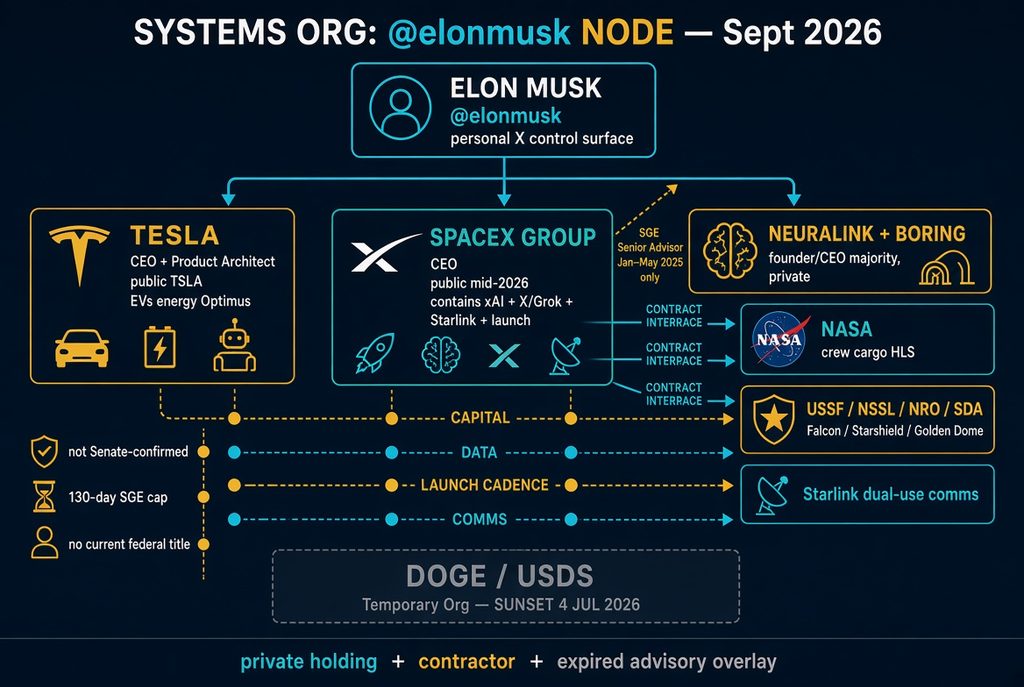
  • Systems Organizational Chart – Elon Musk. Grok Skill Portfolio Example

    Grok Skill Portfolio Example


    @elonmusk (personal X node; ~242M followers)
    │
    ├── Tesla, Inc. (public)
    │ Musk: CEO + Product Architect
    │ Optimus robotics sits here as a division
    │
    ├── SpaceX (public after Jun 2026 IPO)
    │ Musk: Founder, CEO, Chief Engineer
    │ ├── xAI (absorbed Feb 2026)
    │ ├── X Corp / Grok (parked under xAI then SpaceX)
    │ ├── Starlink + Starshield
    │ └── Launch (Falcon 9 / Heavy / Starship)
    │
    ├── Neuralink (private, majority)
    │ Musk: Co-founder / Co-CEO
    │
    ├── The Boring Company (private)
    │
    └── [EXPIRED] DOGE / U.S. DOGE Service Temporary Organization
    Parent: Executive Office of the President
    Charter: EO 20 Jan 2025 → terminate 4 Jul 2026
    Musk: Special Government Employee, Senior Advisor to the President
    (White House Office, not USDS employee)
    Offboarded ~30 May 2025 (130-day SGE limit)
    Acting Administrator during life: Amy Gleason
    Day-to-day ops: Steve Davis (unofficial CoS)
    Co-announced with Vivek Ramaswamy at start; Ramaswamy exited early

    Leadership + Trump-admin context

    Jul 4 2026: Charter expires. DOGE X account posts that the “mission continues” as a principle, not as an organization. Agencies are re-hiring. GAO still litigating savings claims and ethics paperwork.

    Jan 20 2025: EO creates U.S. DOGE Service Temporary Organization inside EOP; sunset written as 4 Jul 2026. Trump publicly named Musk the leader. DOJ later argued he was “just an advisor.” A federal judge called him de facto leader.

    Musk legal status: Special Government Employee in the White House Office. Cap = 130 days in a 365-day window. He was not USDS Director on paper. Amy Gleason was acting administrator.

    May 2025: Musk exits after Tesla investor pressure + public clash with Trump over the July 2025 reconciliation bill. Steve Davis and core staff leave with him.

    Persistent government interface (the real systems edge)

    This is the part that survives DOGE:

    • SpaceX is the only launcher currently flying NSSL payloads after ULA Vulcan and Blue Origin New Glenn problems. NSSL Phase 3 Lane 2: SpaceX assigned the bulk of “must-go” missions.
    • NRO proliferated architecture: 14+ dedicated Falcon missions by mid-2026; more scheduled through 2029.
    • Golden Dome / SDA / Starshield: multi-billion 2026 awards ($4.16B AMTI sensors, $2.29B space data network backbone, plus launch task orders). SpaceX government backlog cited >$22B across NASA + USSF + NRO + SDA.
    • NASA: crew, cargo, HLS — still a core customer.

    Pattern: single private firm as launch + LEO comms + ISR backbone. That is a systems-resilience and vendor-lock problem, not a Twitter-bio problem.

    Systems lesson

    Single-point cadence risk. If Falcon cadence drops, NSSL and NRO proliferated architecture slip. That is the actual org-chart vulnerability.

    Control surface ≠ agency. @elonmusk on X is a high-bandwidth personal broadcast bus. Decisions flow through equity + CEO titles, not through 5 U.S.C. reporting lines.

    Temporary overlay vs durable contractor graph. DOGE was an 18-month EOP experiment with a hard delete date. SpaceX/NRO/USSF contracts are multi-year and growing.

    Observability gap. CISA publishes org charts and authorities. Musk-system reporting is 10-Ks, launch manifests, and GAO after-action on DOGE. Different information architectures.

    Watch items

    • GAO-26-108403 and follow-ons on DOGE personnel/ethics.
    • NSSL reassignments off grounded competitors onto Falcon.
    • Whether any DOGE functions permanently landed in OMB/OPM vs fully died.
    • SpaceX post-IPO governance vs Musk dual-CEO load (Tesla + SpaceX).

    Sources: GAO, EO 14158 / USDS charter reporting, Wikipedia DOGE page (updated Sep 2026), Space Force / SpaceNews / TechTimes contract coverage, Bloomberg/AP company-structure reporting. Numbers on “savings” are DOGE self-reported and contested by GAO — treat as claimed, not audited.